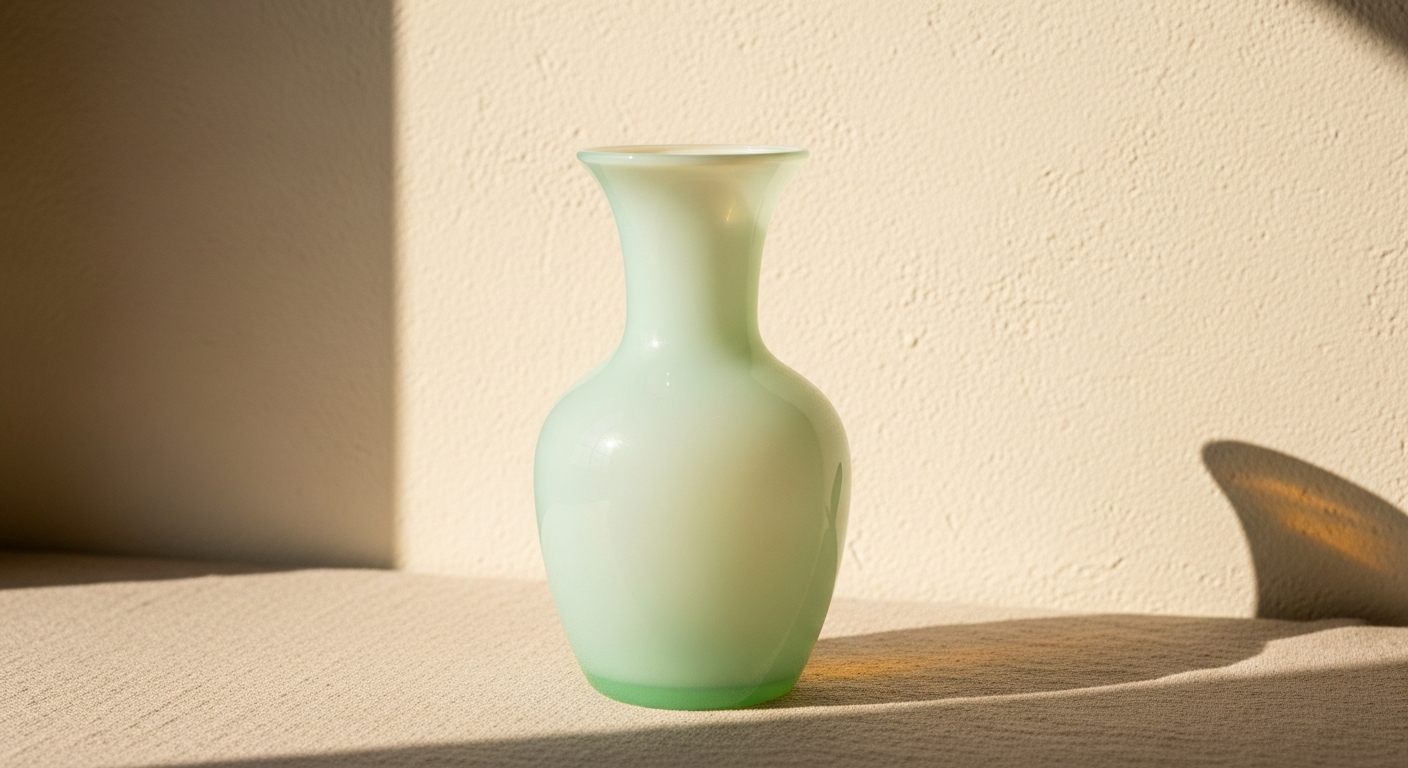
A quietly perfect piece of mid-century French glass — the kind of object that doesn’t announce itself but changes the temperature of a shelf the moment you set it down.
The vase surfaced at a farmhouse clearance two kilometres outside Bonnieux, on one of those mornings where the mist hasn’t quite burned off the valley and everything smells like wet stone and rosemary. It was sitting on a kitchen windowsill between a stack of Provençal boutis quilts and a cardboard box of mismatched Christofle cutlery. The family had been using it as a water carafe — there’s something moving about an object whose beauty was incidental to its owners.
About the glass
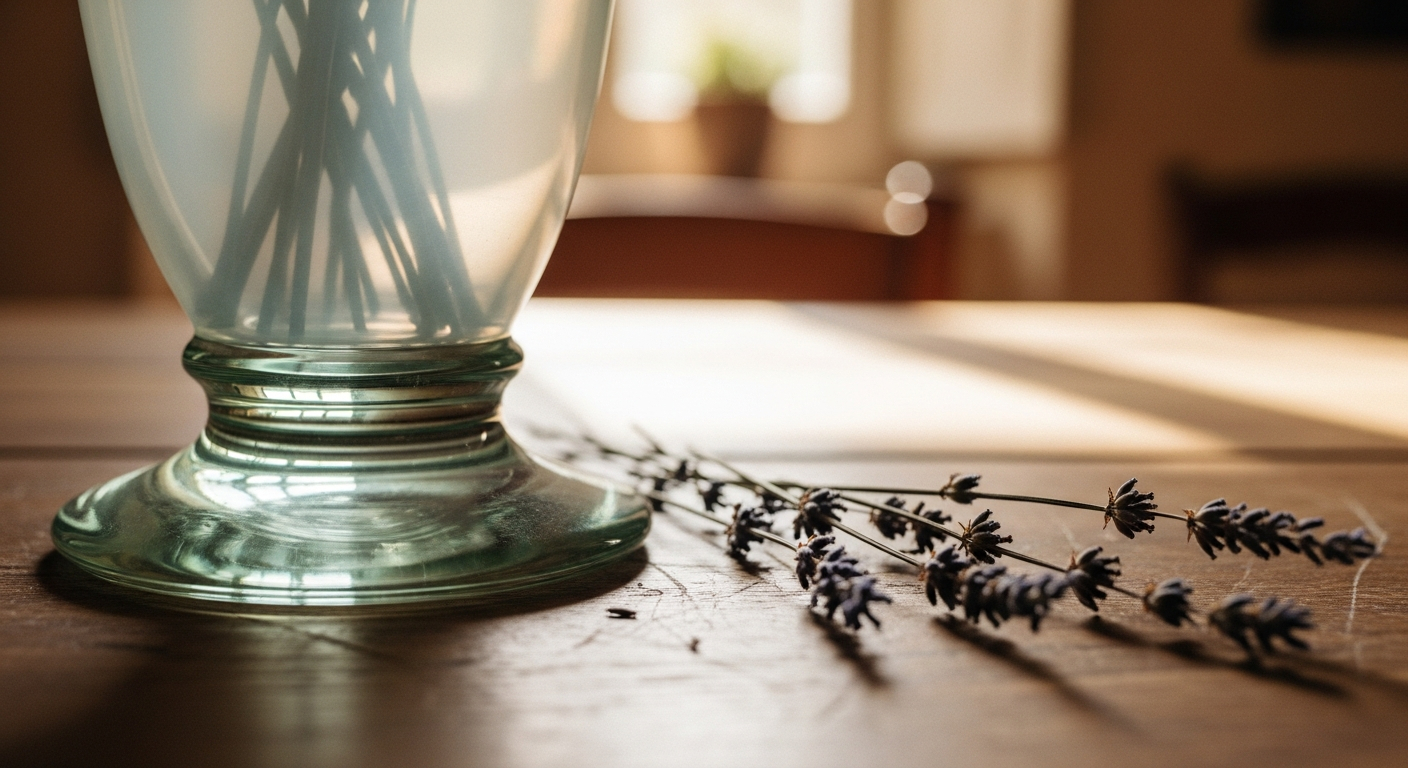
Opaline glass was produced across France and Italy from the mid-nineteenth century onward, but the softer, less saturated tones — this pale celadon among them — tend to date from the late 1950s and 1960s, when Murano and small French ateliers were simplifying their palettes. This piece has no maker’s mark, which is typical of the period. The celadon tint only reveals itself in direct afternoon light; indoors under a bulb, it reads as a warm, dense white.
The colour changes with the hour. Morning it’s milk. By four o’clock it’s the palest jade.
The form is classical — a gentle flare at the lip, a stable base with enough weight to anchor a handful of garden stems without tipping. No chips, no internal haze, no repairs. It has that particular density of well-made opaline: pick it up and it’s heavier than you expect, which is always a good sign.
Best with a single branch of something sculptural — olive, quince, dried grasses — or left empty as a form in its own right. It’s the kind of piece that earns its place on a mantel and stays there for thirty years.