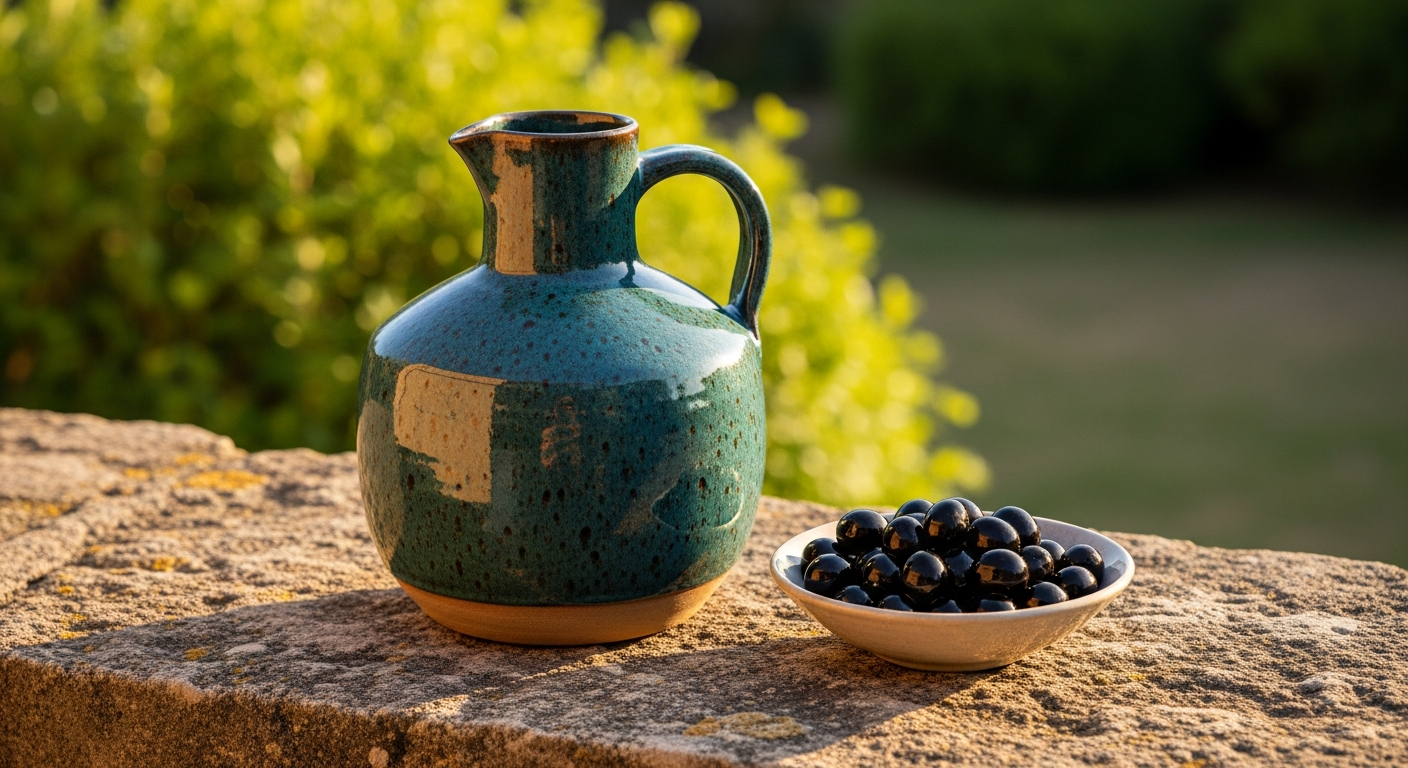
A small, generously proportioned pitcher from Vallauris in a deep teal glaze scattered with brown speckle — the kind of studio ceramics that feels better in the hand than it looks in a photograph.
This came out of a box lot at an estate sale outside Mougins — one of those lots where you buy six things to get the one you want. The pitcher was the one we wanted. It was wrapped in newspaper from 1983, which gives us an approximate date, though the piece itself is likely from the early to mid-1970s based on the glaze palette and the form.
Vallauris and its legacy
Vallauris has been a pottery town since Roman times, but its modern reputation was made by Picasso, who arrived in 1948 and spent the next two decades producing ceramics at the Madoura studio. His presence drew dozens of potters to the town, and by the 1960s and 70s Vallauris was producing an extraordinary range of studio ceramics — much of it experimental, colourful, and completely unpretentious. This pitcher belongs to that tradition: handmade, hand-glazed, signed with a small incised mark on the base that we haven’t been able to attribute to a specific potter.
The teal glaze is deep and lustrous, with a network of fine crazing that’s consistent with age and entirely stable. The brown speckle appears to be iron oxide introduced into the glaze — it clusters around the belly and thins near the rim, suggesting the pitcher was dipped rather than poured. The handle is thick and comfortable, and the spout pours cleanly. It holds about half a litre — the right size for water, wine, or olive oil at a table for four.
We love unknown studio marks. It means the piece was made by someone who cared about the work more than the signature, and it means you own something that can’t be looked up, priced by algorithm, or reduced to a market category. It’s just a beautiful pitcher, on its own terms.